Welcome to Banknotemaniac

Thank you for your time and I hope you liked the blog. Do not hesitate to contact me!

European banknotes

Look for information of these banknotes, their history and secrets.

American banknotes

Look for information of these banknotes, their history and secrets.

Asian banknotes

Look for information of these banknotes, their history and secrets.

War paper-money

Look for information of these war banknotes, their history and secrets.

Translate

Mostrando entradas con la etiqueta Spain. Mostrar todas las entradas

viernes, 15 de febrero de 2019

Cuba (1896-1905)

This serie of banknotes belongs to the last one under Spanish control, in the period in which USA declared and won the war against Spain. There are banknotes of 1 peso, 5 pesos, 10 pesos, 20 pesos and 50 pesos.

1 peso (un peso)

This banknotes worth 1 pesos was first circulated May the 15th of 1896. On the main side center you can two coat of arms: the right one is the one of Spain and the left one, Havana one. They are topped with Borbon's dinasty crown and in the lower part there are two globes (Old World, Europe; New Wrld, America), a bundle of sugar cane and caduceus (symbol of commerce). It has four 1's, one in each upper corner and one left and another right the written value of the banknote in Spanish.
In this times, 1 peso was equivalent to 5 Spanish pesetas. On the other side you can see in the regent queen Maria Christina (the legal king was under age), with with the name of the National Bank in Spanish (Banco español de la isla de Cuba). It has two 1's and geometric elements surrounding them. This banknote has no digital watermark. The size of this banknote is 9.4 cm x 4.6 cm.

5 pesos (cinco pesos)

This banknotes worth 5 pesos was first circulated May the 15th of 1896. On the main side center you can see Roman god Mercury (Hermes for Greeks), messenger of gods, god of trade, thieves and travelers. He is sat on a beach and ships sail in the horizon.  The inner part has gold colour. It has six 5's, one in each corner and one left and another right. In this times, 1 peso was equivalent to 5 Spanish pesetas. The banknote is decorated is geometric elements.
On the other side you can see in the middle a circle with Borbon kings coat of arms of Castile and Leon, with the name of the National Bank in Spanish (Banco español de la isla de Cuba). It has an stamp that says "plata" (silver, and has crowns too) that means that this banknote was exchanged for a silver coin of the same value (it helped people not to mistrust). This banknote has no digital watermark. The size of this banknote is 12.3 cm x 7 cm. 

10 pesos (diez pesos)

This banknotes worth 10 pesos was first circulated May the 15th of 1896. On the main side center you can see an ox cart and workers picking up tobacco leaves for the Cuban cigars.  The inner part has grey colour. It has eight 10's, one in each corner and four in the middle. In this times, 1 peso was equivalent to 5 Spanish pesetas. The banknote is decorated is geometric elements.
On the other side you can see in the middle a circle with Borbon kings coat of arms of Castile and Leon, with the name of the National Bank in Spanish (Banco español de la isla de Cuba). It has an stamp that says "plata" (silver, and has crowns too) that means that this banknote was exchanged for a silver coin of the same value (it helped people not to mistrust). It has six 10's and decorative elements too. This banknote has no digital watermark. The size of this banknote is 14.6 cm x 9.3 cm.

jueves, 7 de febrero de 2019

Spain (1992-2002)

This serie of banknotes belongs to the period in which it was celebrated the 500th anniversary of the discovery of America, a period in which Spain held the 1992 Olympic Games in Barcelona and was held in Seville at the Universal Exhibition, modernizing the Spanish economy and society, the development of the autonomous State and there was a significant economic stagnation. In 1994 and 1995 there was the discovery of cases of corruption, the state terrorism of the GAL, which led the center-right Popular Party to win general elections in 1996, making José María Aznar president of the government (with the support of Catalan nationalists) allowing Spain to be part of the member countries of the European Union that would share the new single currency, the euro (achieved at the end of 1997). The terrorism of ETA continued active and after kidnapping and assassination of the councilman of the PP of Ermua Miguel Ángel Blanco provoked a multitudinal movement of repulsion in the Basque Country and in the rest of Spain known as the Spirit of Ermua. There are banknotes of 1,000 pesetas, 2,000 pesetas, 5,000 pesetas and 10,000 pesetas.  

1,000 pesetas (mil pesetas)

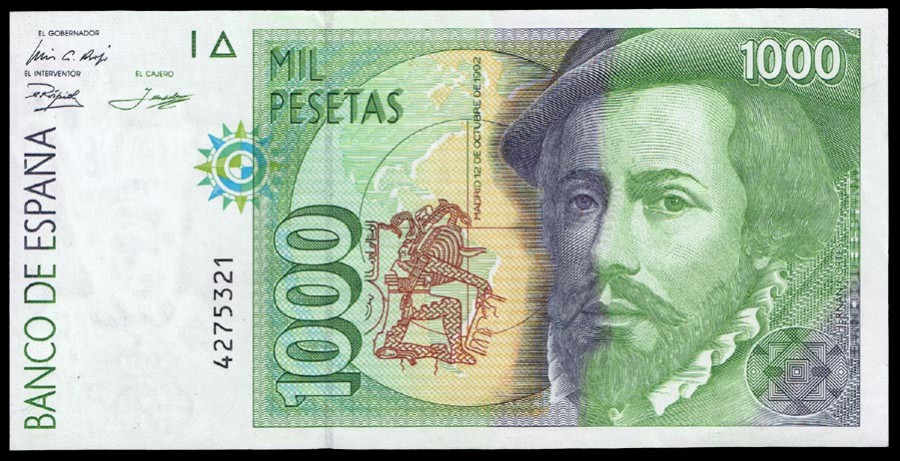
This banknote worth 1,000 pesetas was first circulated in October the 12th 1992. On the main side right it can be seen Hernán Cortés, 16th century Spanish conquistador who led the expedition that initiated the conquest of Mexico and the end of the Mexica empire. Next to him appear two 1,000's, a globe, the written value of the banknote and an Aztec symbol and in the left, the name of the National Bank in Spanish (Banco de España). The rest of the banknote is completed with decorative elements.
On the other side of the banknote has Francisco Pizarro, a 16th century conqueror who leaded the conquer of Peru. Moreover there are two 1,000's, an astrolabe, a helmet with a sword, the Spanish coat of arms, Lima's cathedral (where Pizarro is buried) and the written value of the banknote and the name of the National Bank. This banknote has Moctezuma II (first Aztec king who had contact with the conquerors) as digital watermark and a security thread too. The size of this banknote is 13 cm x 6.5 cm.

2,000 pesetas (dos mil pesetas)

This banknote worth 2,000 pesetas was first circulated in April the 24th 1992. On the main side right it can be seen José Celestino Mutis, 18th century Spanish priest, botanist, geographer, mathematician, doctor and teacher of the Universidad del Rosario, in Bogotá and one of the main authors of the Spanish Universalist School. Next to him appear two 2,000's, America continent in a globe, a Mutisia flower, the written value of the banknote and in the left, the name of the National Bank in Spanish (Banco de España)
The rest of the banknote is completed with decorative elements. On the other side of the banknote has the Neogothic entrance to the Botanic Garden of Madrid, founded by Charles III in 1788. Moreover there are two 2,000's, Mutisia flowers and fleur de lis, the Spanish coat of arms and the written value of the banknote and the name of the National Bank. This banknote has fray Bartolomé de Las Casas (Spanish encomendero and then Dominican friar, chronicler, bishop of Chiapas, main defender of the indigenous) as digital watermark and a security thread too. The size of this banknote is 13.8 cm x 6.8 cm.


5,000 pesetas (cinco mil pesetas)

This banknote worth 5,000 pesetas was first circulated in October the 12th 1992. On the main side right it can be seen Christopher Colombus, navigator, cartographer, admiral, viceroy and governor general of the West Indies (at the service of the Crown of Castile), famous for having discovered America, on October 12th, 1492. Next to him appear two 5,000's, America in a globe, the Catholic Monarchs, two boats, the written value of the banknote and an Aztec symbol and in the left, the name of the National Bank in Spanish (Banco de España)

The rest of the banknote is completed with decorative elements. On the other side of the banknote has an armillary sphere on the nao Santa María and a compass of sailor. Moreover there are two 5,000's, a rudder, Greek and Latin characters with Colombus name, the Spanish coat of arms and the written value of the banknote and the name of the National Bank. This banknote has Martín Alonso Pinzón (Spanish navigator and explorer, co-discoverer of America together with Columbus) as digital watermark and a security thread too. The size of this banknote is 14.6 cm x 7.1 cm.

10,000 pesetas (diez mil pesetas)

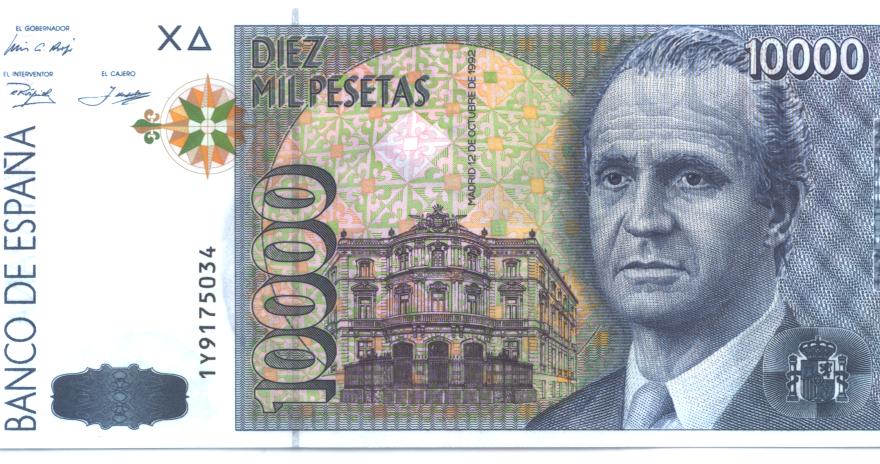
This banknote worth 10,000 pesetas was first circulated in October the 12th 1992. On the main side right it can be seen Juan Carlos I, Spanish king who took the country from Franco's dictatorship to the transition to democracy. Next to him appear two 10,000's, Linares Palace (where Casa de América is placed) in Madrid, the written value of the banknote and in the left, the name of the National Bank in Spanish (Banco de España). The rest of the banknote is completed with decorative elements.
On the other side of the banknote has Jorge Juan y Santacilia, Spanish humanist, naval engineer and scientist who reformed the Spanish naval model and measured the longitude of the terrestrial meridian (demonstrating that the Earth is flattened at the poles). Moreover there are two 10,000's, the maths methods he used for his hypothesis and the boat he used in his journeys, the written value of the banknote and the name of the National Bank. This banknote has Antonio de Ulloa y de la Torre-Giralt (Spanish navigator and explorer, who measured a meridian near the equator (Quito) and another near the pole (Lapland)) as digital watermark and a security thread too. The size of this banknote is 15.4 cm x 7.4 cm.

Spain (1935-1939)

This series of banknotes belong to the end of the II Spanish Republic and the Spanish Civil War. There are banknotes of 50 céntimos, 1 peseta, 2 pesetas, 5 pesetas, 10 pesetas, 25 pesetas, 50 pesetas, 100 pesetas.

Before the Civil War

5 pesetas (cinco pesetas)

This banknote worth 5 pesetas was first circulated in 1935. On the main side left, you can see a woman (who represents the Republic) and wears an ear wheat, symbolizing ordinary people (who were mainly part of the Republic side). In the right side appears the written value of the banknote, two 5's in the upper part of the banknote and the name of the National Bank in Spanish (Banco de España).
The lower part has a mosaic like the edition from 1931. On the other side you can see a 5 in the middle with the written value of the banknote and the name of the National Bank, surrounded with geometric decorative elements. This banknote has no digital watermark. The size of the banknote is 10 cm x 5.9 cm.


10 pesetas (diez pesetas)

This banknote worth 10 pesetas was first circulated in 1935. On the main side right, you can see a woman (who represents the Republic) and wears a crown made of walls, symbolizing the Republic (Spanish Republic coat of arms had thi crown too). In the left side appears the written value of the banknote, two 10's in the right part of the banknote and the name of the National Bank in Spanish (Banco de España).
The lower part has a mosaic like the edition from 1931. On the other side you can see a 5 in the middle with the written value of the banknote and the name of the National Bank, surrounded with geometric decorative elements. This banknote has no digital watermark. The size of the banknote is 11.1 cm x 7.1 cm.


50 pesetas (diez pesetas)

This banknote worth 50 pesetas was first circulated in July the 22nd 1935. On the main side right, you can see Santiago Ramón y Cajal, a Spanish pathologist, pioneer of modern neuroscience, who won Nobel prize in 1906. In this left it can be seen the written value of the banknote. In the upper part appears the name of the National Bank (Banco de España), the Spanish Republic coat of arms and there are four 50's, one in each corner.
In the left and right side appear two Spanish republic allegory as columns, one playing the trumpet and the other with an owl (wisdom symbol). On the other side you can see a building in Ramon y Cajal's honour in Retiro Park (Madrid), done by Victorio Macho. It has a 50, the name of the National Bank and a gap for the watermark. This banknote has Ramon y Cajal's face as digital watermark. The size of the banknote is 13 cm x 9 cm.

Republican side

50 céntimos (cincuenta céntimos)

This banknote worth 50 céntimos was first circulated in 1937. On the main side left, you can see a woman (who represents the Republic) and wears a hood, symbolizing workers (who were mainly part of the Republic side) inside the frame. All the content of this part is inisde a border with four 50's (one in each corner). It also has the name of the country, the written value of the banknote and the name of the entity which coined the banknote (Ministerio de Hacienda).
On the other side you can see in the middle a 50 and the written value of the banknote surrounded with geometric shapes and decorative elements. This banknote has no digital watermark. The size of the banknote is 8.4 cm x 4.9 cm.


1 peseta (una peseta)

This banknote worth 1 peseta was first circulated in 1937. On the main side left, you can see Winged Victory of Samothrace, a marble Hellenistic sculpture of Nike (Greek goddess of victory) from around II BC. In the right appears Spanish coat of arms during Republic, with the only difference of having a crown made of walls (instead of Bourbon's one). There are two 1's, one in each corner, the written value of the banknote and the name of the entity which coined the banknote (Ministerio de Hacienda).
On the other side you can see in the middle Plaza de Cibeles' fountain, a neogothic sculpture in Madrid named after Cybele, a Phrygian goddess. It is surrounded with geometric shapes and decorative elements and has four 1's, one in each corner. This banknote has no digital watermark. The size of the banknote is 9.1 cm x 5.2 cm.

2 pesetas (dos pesetas)

This banknote worth 2 pesetas was first circulated in 1938. On the main side center, you can see a woman (who represents the Republic) and wears a hood, symbolizing workers (who were mainly part of the Republic side) inside the frame. In the upper part appears the name of the Republican side state in Spanish (República española). There are two 2's, one in each corner, the written value of the banknote and the name of the entity which coined the banknote (Ministerio de Hacienda y Economía).
On the other side you can see in the middle the bridge Puente de Toledo, a Baroque bridge across Manzanares river in Madrid. It is surrounded with geometric shapes and decorative elements and has two 2's, one in each side. This banknote has no digital watermark. The size of the banknote is 9.4 cm x 5.5 cm.

5 pesetas (cinco pesetas/bost pezeta)

This banknote worth 5 pesetas was first circulated in January the 1st 1937. On the main side center it can be seen the written value of the banknote and the emition date, over autonomous region of Basque Country, where it was coined. In the upper part appears the name of the National Bank in Spanish (Banco de España) and the city where was printed, Bilbao. There are four 5's, one in each corner, and decorative elements too.
On the other side appears a Basque sheperd with a Basque shepherd dog and a flock of sheep. It is surrounded with geometric shapes and decorative elements, has a 5 and the name of the National Bank. This banknote has no digital watermark. The size of the banknote is 9.8 cm x 5.4 cm.


25 pesetas (cinco pesetas/hogeita bost pezeta)

This banknote worth 25 pesetas was first circulated in January the 1st 1937. On the main side center it can be seen the written value of the banknote and the emition date, over autonomous region of Basque Country, where it was coined. In the upper part appears the name of the National Bank in Spanish (Banco de España) and the city where was printed, Bilbao. There are four 25's, one in each corner, and a stamp sayin that the bank has the money to pay the banknote's value. decorative elements too
Moreover there are decorative elements with acorns and oak branches. On the other side appears a blast furnace with ssome workers, a very common job in the province of Vizcaya (Bizkaia in Basque). It is surrounded with geometric shapes and decorative elements, has a 25 and the name of the National Bank. This banknote has no digital watermark. The size of the banknote is 11.8 cm x 7.9 cm.

Spain (1965-1970)

This serie of banknotes belongs to the one of last of the dictatorship of Franco, during in which Equatorial Guinea got independent and Juan Carlos I of Spain was proclaimed Franco's successor. There are banknotes of 1 peseta, 5 pesetas, 100 pesetas, 500 pesetas and 1,000 pesetas.

100 pesetas (cien pesetas)

This banknotes worth 100 pesetas was first circulated November the 19th of 1965. On the main side center, you can see Gustavo Adolfo Bécquer, a Spanish poet from the 19th century who belongs to post-romanticism and realism, being one of the most important writters in Spanish. Next to him appears the Spanish coat of arms from Franco's times, the written value of the banknote and the name of the National Bank in Spanish (Banco de España). In its left appears a gap used for the digital watermark and the representation of one of his poems. 
There are geometric elements in the border and floristic ones.On the other side you can see the poet's muse, to whom Bécquer composed many of his poems. In her right there's the digital watermark. In the left appears Seville's cathedral (biggest gothic cathedral in the world), city where he was born. This side has three 100's, the written value of the banknote and borders with geometric elements. This banknote has Julia Espín (Bécquer's Muse) as digital watermark. The size of this banknote is 13.6 cm x 8.8 cm.

Spain (1931-1935)

This serie of banknotes is the first one of the II Spanish Republic, having first a left-wing government leaded by Manuel Azaña and then a conservative one by Alejandro Lerroux, having Niceto Alcalá-Zamora as Head of State. There are banknotes of 25 pesetas, 50 pesetas, 100 pesetas, 500 pesetas and 1,000 pesetas.

25 pesetas (veinticinco pesetas)

This banknotes worth 25 pesetas was first circulated April the 25th of 1931. On the main side right, you can see Vicente López, a Spanish neoclasic painter. In the left, it can be seen an oval used for the digital watermark. There are four 25's, one in each corner; in the middle appears the written value of the banknote and in the upper part, the name of the National Bank in Spanish (Banco de España). In the rest of the banknote, there is a mosaic, in honour of former Muslim heritage.
On the other side you can see a part of Alegoría de la música (Music allegory), one of Vicente López's main paintings. It can be seen three 25's, but in the left downside corner, the written value of the banknote and the name of the National Bank. There is also a frame in which appears the digital watermark and decorative borders. This banknote has a woman with a helmet (representing the Republic) as digital watermark. The size of this banknote is 12.1 cm x 7.9 cm. 

50 pesetas (cincuenta pesetas)

This banknotes worth 50 pesetas was first circulated April the 25th of 1931. On the main side left, you can see Eduardo Rosales , a Spanish purismo painter, with his favourite topic being history. In the right, it can be seen an oval used for the digital watermark. There are four 50's, one in each corner; in the middle appears the written value of the banknote and in the upper part, the name of the National Bank in Spanish (Banco de España). In the rest of it, there is a mosaic in honour of Muslim heritage.
On the other side you can see La muerte de Lucrecia (Lucretia's dead), one of Eduardo Rosales' main paintings. It can be seen one 50's, in the left downside corner; the written value of the banknote and the name of the National Bank. There is also a gap  in which appears the digital watermark. There is a column in each side and decorative borders. This banknote has a woman with a helmet (representing the Republic) as digital watermark. The size of this banknote is 13.1 cm x 8.5 cm.

100 pesetas (cien pesetas)

This banknotes worth 100 pesetas was first circulated April the 25th of 1931. On the main side left, you can see Gonzalo Fernández de Córdoba (also known as Gran Capitán), a 15th-16th century Spanish general who fought in the Conquest of Granada and the Italian Wars. In the right, it can be seen an oval used for the digital watermark. There are four 100's, one in each corner; in the middle appears the written value of the banknote and in the upper part, the name of the National Bank in Spanish (Banco de España).

In the rest of it, there is a mosaic, in honour of former Muslim heritage. On the other side you can see El Gran Capitán encuentra, al día siguiente de la batalla de Ceriñola, el cadáver de su enemigo el Duque de Nemours (Gran Capitán finds, the day after Ceriñola battle, the corpse of his enemy, Nemours Duch), a José Casado del Alisal painting. It can be seen one 100's, in the left downside corner. There is also a gap in which appears the digital watermark. There is a column in each side and decorative borders. This banknote has a knight with a helmet as digital watermark. The size of this banknote is 14.1 cm x 9.1 cm.

Spain (1951-1953)

This serie of banknotes is the first one after the period of autarchy comes to an end, as Spain is progressively accepted internationally. There are banknotes of 1 peseta, 5 pesetas, 50 pesetas, 500 pesetas and 1,000 pesetas.

1 peseta (una peseta)

This banknotes worth 1 peseta was first circulated in November the 19th of 1951. On the main side right, you can see Don Quixote of La Mancha, main character of the Spanish most known book written by Miguel de Cervantes. In the left appears the written value of the banknote and the name of the National Bank in Spanish (Banco de España). There are four 1's, one in each corner and geometric decorative elements.
On the other side of the banknote it can be seen a shield, an armour, a spear and books, all objects related to the literacy character previous mentioned. In the left and right side of the image there are two 1's and the rest of the banknote is fulled with decorative elements. This banknote has no digital watermark. The size of this banknote is 8.4 cm x 6.1 cm. 


5 pesetas (cinco pesetas)

This banknotes worth 5 pesetas was first circulated in August the 16th of 1951. On the main side left, you can see Jaime Blames, a Spanish 19th century philosopher, teologist and sociologist who didn't belong to any school or movement. In the center appears the written value of the banknote and the name of the National Bank in Spanish (Banco de España) and in the right, a gap for the digital watermark. There are four 5's, one in each corner and geometric decorative elements. 

On the other side of the banknote it can be seen picture of the Roman bridge and cathedral of the birth place of Jaime, Vich (Vic in Catalan) in Gerona (Girona in Catalan). In the left there's a gap for the digital watermark and in the right, a 5. The rest of the banknote is fulled with decorative elements and the written value of the banknote. This banknote has a portrait of Jaime Balmes as digital watermark. The size of this banknote is 11 cm x 6 cm. 

Spain (1928-1931)

This serie of banknotes is the last one of dictatorship of  Primo de Rivera (who got unpopular because of the economic situation and the lack of freedom) and the kingdom of Alfonso XIII (when the II Republic was proclaimed). There are banknotes of 25 pesetas, 50 pesetas, 100 pesetas, 500 pesetas and 1,000 pesetas.

25 pesetas (veinticinco pesetas)

This banknotes worth 25 pesetas was first circulated August the 15th of 1928. On the main side right, you can see Pedro Calderón de la Barca, a Spanish 17th century dramatist, poet and writer of Spanish Golden Age. His work is considered the culmination of Spanish Baroque threater. In the center is his monument in Santa Ana square, in Madrid. In the left, it can be seen a gap used for the watermark and in the center, the written value of the banknote and the name of the National Bank in Spanish (Banco de España). In the rest of it, there is a mosaic, two 25's and there are decorative elements. On the other side you can see a part of La devoción de la cruz (cross devotion) by Domingo Muñoz. It can be seen two 25's, in the opposite corners. There is also a space in which appears the digital watermark and decorative borders. This banknote has a woman in Classic style as digital watermark. The size of this banknote is 12.1 cm x 8 cm.

50 pesetas (cincuenta pesetas)

This banknotes worth 50 pesetas was first circulated August the 15th of 1928. On the main side right, you can see Diego de Velázquez, a 17th century Spanish painter, the best on in the Spanish Golden Age. In the center is Prado Museum (where there are many of his paintings), in Madrid. In the right, it can be seen a gap used for the watermark, the written value of the banknote and the name of the National Bank in Spanish (Banco de España). In the rest of it, there is a mosaic, three 50's and decorative elements too. 

On the other side you can see La rendición de Breda (Breda's rendition), one of Velázquez main paintings. It can be seen one 50, in the left upside corner. There is also a frame in which appears the digital watermark, the Spanish coat or arms and decorative borders. This banknote has a woman in Baroque style (maybe Velázquez's wife) as digital watermark. The size of this banknote is 13 cm x 9.1 cm.

100 pesetas (cien pesetas)

This banknotes worth 100 pesetas was first circulated August the 15th of 1928. On the main side left, you can see Miguel de Cervantes, the 17th century well-known Spanish writer, author of Don Quixote. In the center is the monument to Cevantes, Don Quixote and Sancho (main characters of the book) in España Square, in Madrid; the written value of the banknote and the name of the National Bank in Spanish (Banco de España). In the right, it can be seen a gap used for the watermark. 
In the rest of it, there is a mosaic, two 100's and decorative elements (like colums) too. On the other side you can see Encuentro de Don Quijote con los Duques (Meeting between Don Quixote and the Dukes) by Luis Menéndez Pidal. It can be seen two 100's, in the opposite corners and there are decorative borders. The digital watermark of this banknote is a man (who is said to be El Quijote). The size of this banknote is 14.6 cm x 10 cm.

Spain (1953-1965)

This serie of banknotes belongs to period in which Spain was again accepted internationally (thanks to joining NATO), tourism and Spanish economy developed and the Spanish Protectorate of Morocco got independence. There are banknotes of 1 peseta, 5 pesetas, 100 pesetas, 500 pesetas and 1,000 pesetas.

1 peseta (una peseta)

This banknotes worth 1 peseta was first circulated July the 22nd of 1953. On the main side right, you can see Álvaro de Bazán, duque de Santa Cruz (Santa Cruz Duch), 16th century Spanish admiral who was never defeated in his fifty-year old career. In his left appears Spanish coat of arms from Franco times, the written value of the banknote and the name of the National Bank in Spanish (Banco de España).
The banknote is decorated is geometric and nauvigational instruments. On the other side you can see "La Loba" (The She-Wolf), his personal gally, feared by Spanish enemies and regarded with hope among Spanish sailors and allies. It has two 1's too, one in each side of the image, the written value of the banknote and the name of the National Bank. There are decorative borders with geometric motif. This banknote has no digital watermark. The size of this banknote is 8.8 cm x 5.9 cm. 


5 pesetas (cinco pesetas)

This banknotes worth 5 pesetas was first circulated July the 22nd of 1954. On the main side right, you can see Alfonso X of Castile, known as "The Wise", was a 13th century king who fostered the development of a cosmopolitan court than encouraged learning. In his left appears Spanish coat of arms from Franco times, the written value of the banknote, the name of the National Bank in Spanish (Banco de España) and four 5's, one in each corner.
The banknote is decorated is geometric elements. On the other side you can see Biblioteca Nacional de España (Spanish National Library), one of the largest libraries in the world. It has a 5 in the left and in the right the gap for the digital watermark. There are decorative borders with geometric motif. This banknote has Alfonso X's portrait as digital watermark. The size of this banknote is 11 cm x 6 cm. 


25 pesetas (veinticinco pesetas)

This banknotes worth 25 pesetas was first circulated July the 22nd of 1954. On the main side left, you can see Isaac Albéniz, a Spanish pianist and composer knwon for his work based on folk music. In his right appears Spanish coat of arms from Franco times, the written value of the banknote, two 25's and the name of the National Bank in Spanish (Banco de España). The banknote is decorated is geometric and still life.
On the other side you can see in the right and image of  Patio de los Leones (Court of the Lions), the main and most beautiful of the courtyards in La Alhambra, in Granada. In the left there's a gap for the watermark and the name of the National Bank. The other side has two 25's and decorative borders and the lower part, the written value of the banknote. This banknote has Albéniz's face as digital watermark. The size of this banknote is 12.1 cm x 7.7 cm.

100 pesetas (cien pesetas)

This banknotes worth 100 pesetas was first circulated April the 7th of 1953. On the main side center, you can see Julio Romero de Torres, a Spanish painter from the 19th century who belongs to Costumbrismo. In his left appears Spanish coat of arms from Franco times, the written value of the banknote, four 100's and the name of the National Bank in Spanish (Banco de España). The banknote is decorated is geometric and still life.
On the other side you can see a painting of Julio Romero, La mujer morena (dark haired woman). This side has four 100's, one on each corner, the written value of the banknote and the name of the National Bank. There are decorative borders with floristic and still life motif. This banknote has one of Romero's models as digital watermark. The size of this banknote is 13.8 cm x 8.7 cm.